People
Frederick Douglass in Ireland
1845 to 1846
Refused a cabin on the ship that carried him here. Four months later he had taken the pledge in Cork, learned three words from O'Connell, and been treated as a man for the first time in his life.
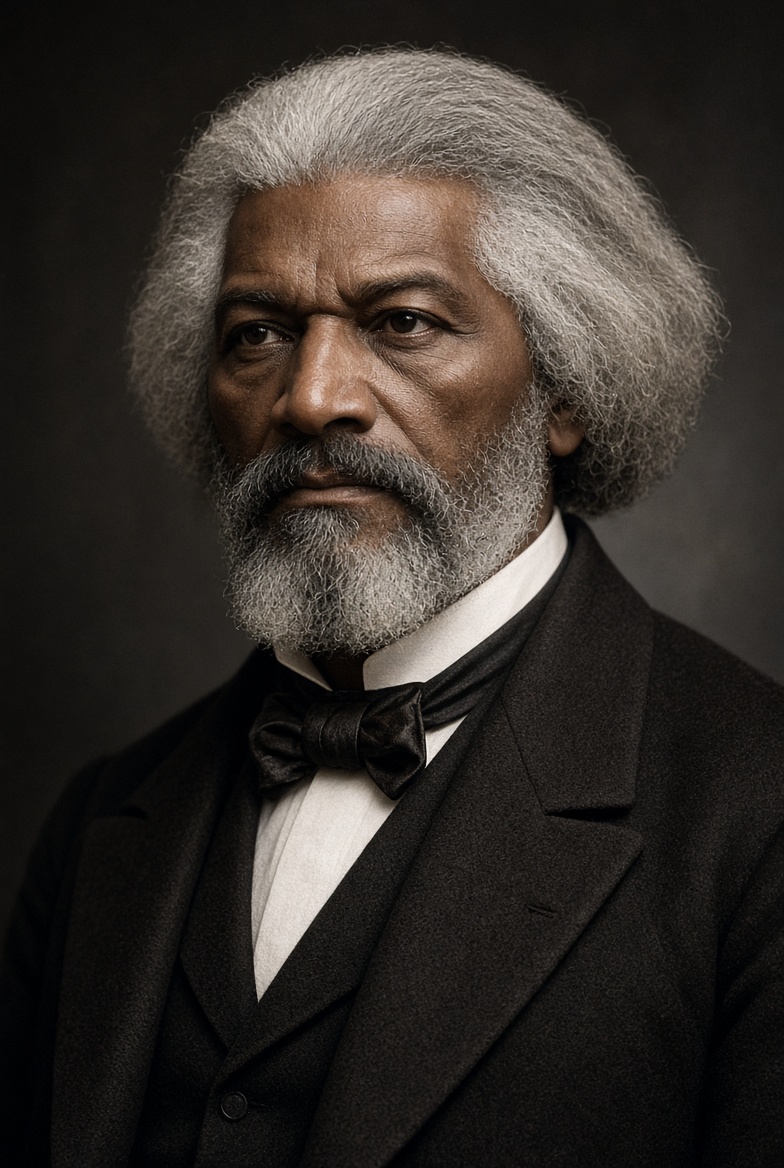
He was refused a cabin on the ship that carried him here.
Frederick Douglass sailed from Boston on the Cambria in August 1845 with his friend James Buffum, and was told he could not be received as a cabin passenger. He went in steerage. His own account of why is exact and it is not about Britain.
American prejudice, he wrote, had triumphed over British liberality and civilization, and had erected a color test.
Midway across, the captain invited him to speak on deck about slavery. Young men from Georgia and New Orleans swore he should not, and offered to throw him overboard. Captain Judkins ordered irons brought up, at which, in Douglass's word, they scampered.
That was the crossing. Four weeks later he wrote to William Lloyd Garrison from Ireland.
I breathe, and lo! the chattel becomes a man.
1845. Why he had to go
He was twenty seven, and seven years out of slavery.
In May 1845 he published the Narrative of the Life of Frederick Douglass. It is the book that made him, and it nearly finished him, because he did what no cautious fugitive would do. He named his owner, named the places, and gave the dates.
Under the law of the United States he was still property. The book told the men who owned him exactly where to look.
So the Irish tour was not a lecture engagement. It was an escape that happened to become a lecture tour, and everybody involved understood that.
31 August 1845. Dublin
He landed in Dublin on the thirty first of August 1845 and stayed about a month.
His host and publisher was Richard Webb, a Quaker printer and a founder of the Hibernian Anti-Slavery Association. Webb brought out an Irish edition of the Narrative, and Douglass wrote his own preface to it, which sounds small and was not. Slave narratives were almost always fronted by a white abolitionist vouching for the author. This one was fronted by the author.
It sold well enough that Webb printed two more editions. The money kept Douglass on the road. [1]
Webb and Douglass did not always like each other, and neither hid it. The business was done anyway.
O'Connell, and three words
He went to hear Daniel O'Connell at a Repeal meeting in Dublin, and the two men met.
Douglass had known the name long before he saw the man. The poor trampled slave of Carolina, he said, had heard the name of the Liberator with joy and hope. O'Connell's abolitionism was not a gesture. He refused American money for Repeal if it came from slaveholders, and it cost him plenty.
Douglass on the oratory: it came down upon the vast assembly like a summer thunder-shower upon a dusty road.
And he took something away from Dublin that he used for the rest of his life. Three words he credited to O'Connell.
Agitate. Agitate. Agitate. [2]
October 1845. Cork
From Dublin he went south through Wexford and Waterford, and reached Cork, where he stayed more than three weeks. It is the part of the tour the record holds best.
He lodged with the Jennings family of Brown Street, Unitarians, on ground now under the Paul Street shopping centre. His friendship with Isabel Jennings was the closest he made in Ireland. He may also have stayed with a Quaker on Patrick Street named William Martin, which is worth a pause, because William Martin is the man who talked Theobald Mathew into the pledge in the first place. [3]
On the twentieth of October 1845 Douglass spoke at the Temperance Institute on Academy Street, on Intemperance and Slavery. Father Mathew introduced him. The South Main Street Quadrille Band played. About two hundred and fifty people came.
The pledge, and what it did and did not mean
Douglass took the pledge from Father Mathew in Cork, and was given a silver badge.
One correction matters here, because the story is usually told as a conversion and it was nothing of the kind. In that same Cork address Douglass said plainly:
That I am a teetotaler is most true. I have been a staunch one for some years.
He arrived in Ireland already abstaining. Taking Mathew's pledge was a public act between two reformers, not a change of life.
And he knew exactly what he was joining. His own line on it is the driest thing either man ever said about the movement.
I now reckon myself with delight the fifth of the last five of Fr Mathew's 5,487,495 temperance children. [4]
Read that number again. Five million, four hundred and eighty seven thousand, four hundred and ninety five. Counted to the last person, in a country that kept no register at all. Douglass quoted it to the digit, and the joke is entirely deliberate.
December 1845. Belfast
He went on to Limerick, to Youghal, to Celbridge, and north to Lisburn, Bangor and Belfast, where he spent the end of the year.
Three Belfast addresses are on the record. On the fifth of December 1845 he spoke on the Cambria riot, his own slave experience and his Irish mission. On the twenty third of December, on the churches and slavery. On the second of January 1846, on Texas, slavery and American prosperity. [5]
The church argument is the one that mattered in Ulster. Douglass pressed the Free Church of Scotland and the Presbyterian and Congregational bodies on money taken from slaveholding congregations in the American South, and he pressed hard. Send back the money was a slogan he made ring in the north of Ireland, and it made him enemies among people who had welcomed him.
1846. What he saw, and the judgement he made
Now the difficult part, and it should not be softened.
Writing to Garrison on the twenty sixth of February 1846, looking back at Ireland, Douglass described what he had walked through.
The streets were almost literally alive with beggars, displaying the greatest wretchedness. Some of them mere stumps of men, without feet, without legs, without hands, without arms.
He described children on cold stone steps late at night in filthy rags, with none to look upon them, none to care for them. He described a cabin. Four mud walls about six feet high, ten feet square, thatched with straw, no floor and no windows, holding a man and his wife and five children and a pig.
And then he drew the comparison that only he could draw. Men and women, married and single, old and young, lie down together, in much the same degradation as the American slaves.
Then he gave his verdict on the cause.
The immediate, and it may be the main cause of the extreme poverty and beggary in Ireland, is intemperance. This may be seen in the fact that most beggars drink whiskey. [6]
He was wrong, and it is worth saying why
That verdict is wrong, and this site has the figures elsewhere. Ireland drank less per head than Britain and far less than France. The poverty he saw was land, tenure and a collapsing potato crop, and the blight had already struck the autumn he arrived.
But consider where the sentence came from.
He wrote it as Father Mathew's guest, weeks after taking Mathew's pledge, in a city organised around the argument that drink was the root of Irish misery. He was repeating the case he had been handed by the people who had housed him and applauded him.
And he was reasoning from his own life. He had watched slaveholders use drink to keep men docile, and he had concluded that sobriety was the first act of a free man. He looked at Ireland and saw the same mechanism.
He was mistaken about Ireland. He was not being careless, and he was not being unkind. He was applying the only key he had, and it did not fit this lock.
1849. The break
Four years later Father Mathew went to America, and Douglass found out what his friend was worth on the one question that mattered to him.
Mathew had signed an anti-slavery petition in 1841 with sixty thousand other Irish people. In America he was invited to say so in public, and he would not. His hosts included the Catholic hierarchy of New York and a great many Irish Americans in the southern states, and speaking would have closed the South to his mission.
Douglass wrote about it in his own newspaper, the North Star, on the seventeenth of August 1849. He called it a disgraceful apostasy. [7]
It is the only hard word in this article and it belongs to Douglass, not to me. He had knelt in Cork and taken the pledge from that man's hand.
1887. What Ireland gave him
He came back once, in 1887, an old man and a famous one, and met the children and grandchildren of the people who had taken him in.
What the four months did for him is not in dispute, because he said it himself, repeatedly, for fifty years.
I find myself regarded and treated at every turn with the kindness and deference paid to white people.
He had spent twenty seven years being a thing. In Ireland, for the first time, he was received as a man, and it changed what he thought was possible for himself.
That is the part worth remembering in a country that has never been sure whether to be proud of its own history. For four months in 1845, in Dublin drawing rooms and a Cork temperance hall and a Belfast meeting house, ordinary Irish people did a decent thing without much thinking about it.
He never forgot it. He was still saying so when he was seventy.