Movements · 2 of 8
Father Mathew
1790 to 1856
Thrown out of Maynooth for having people in for a drink. He went on to halve the drinking of a nation.
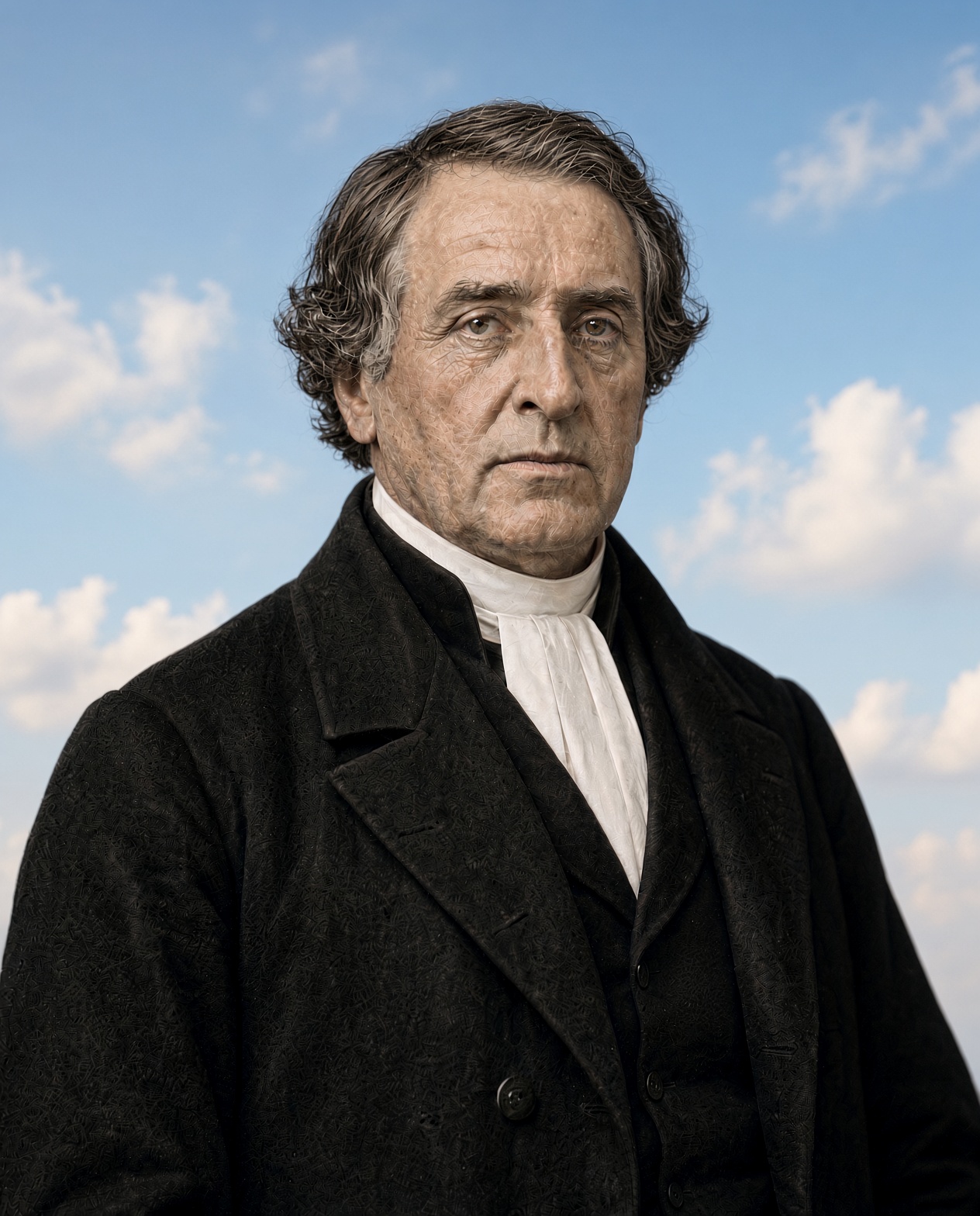
He was thrown out of the seminary for having people in for a drink.
That is not a joke made later. It is the first thing that happened to him, and everything else in his life is a kind of answer to it.
1790. A gentleman's son
Theobald Mathew was born on the tenth of October 1790 at Thomastown Castle near Cashel in County Tipperary, into a family connected to the Earls of Llandaff.
That matters for one reason only. He was comfortable with gentlemen, with Quakers, with mayors and with lords, and later with a President of the United States. A friar from a cabin could not have built what he built, because half of building it was being received in rooms.
1807. Asked to leave
He entered Maynooth in September 1807 and left within a short time to avoid expulsion, for what the record calls a trifling breach of discipline.
The account that has come down is that he invited fellow students to a gathering in his rooms. Seminary discipline after the French Revolution was severe about conviviality, and a young man holding a party in the national seminary was not going to be tolerated.
He went to the Capuchins in Dublin instead, and was ordained in 1814 by Archbishop Daniel Murray. [1]
So the Apostle of Temperance was expelled from Maynooth for hospitality. Nobody who tells his story leaves that out, and nobody should.
Cork, and twenty four years of work nobody remembers
He was sent to the friary in Little Hanover Street in Cork and stayed there for more than two decades before anyone outside Munster had heard of him.
What he did in those years is the part that gets skipped, and it is the part that explains the rest.
He set up free industrial schools to teach a trade. He set up benefit societies, which were the poor man's insurance against sickness and burial. And he bought the Botanic Garden and turned it into St Joseph's Cemetery, open to every denomination, at a time when where a man was buried was a matter of which church would have him.
A priest who buys a graveyard for people who are not his own is a particular kind of priest. It is also why a Quaker felt able to approach him.
1838. Here goes in the name of God
William Martin of the Society of Friends had been working the temperance cause in Cork for years, and getting nowhere, for the obvious reason that the people he needed were Catholic.
He asked Mathew, and kept asking.
In April 1838, at a public meeting in Cork, Mathew signed the total abstinence pledge himself. The words attributed to him are the least ornamental in the whole story.
Here goes in the name of God.
Within nine months a hundred and fifty thousand names were enrolled. Within three years he was claiming millions, and the excise returns were falling off a cliff.
He travelled constantly, administering the pledge in the open air to crowds that no room could hold.
The medals, and the ruin they caused
The medal is where the man and the movement collide.
A pledge is invisible. A medal is not. It let a man show his household, his employer and his parish that he had taken it, and it let a woman decide whether to marry him.
Medals cost money to strike. The intention was that the taker would pay a small sum for one.
Mathew would not refuse a medal to anybody who could not pay, and gave away thousands. He also gave heavily to charity and to church building, which he could no more resist than the medals.
In 1844 he was briefly imprisoned for debt. [2]
That is the year before the potato failed. The man was already broken when the country broke.
1845. Frederick Douglass, on Academy Street
In October 1845 Frederick Douglass was in Cork, seven years out of slavery and twenty seven years old, and Father Mathew introduced him to an audience of about two hundred and fifty at the Temperance Institute on Academy Street.
Douglass took the pledge from him that night and was given a silver badge.
He was not converted. He had been abstaining for years already and said so in that very address, that he was a teetotaler and had been a staunch one for some years. Taking the pledge in Cork was a public act between two reformers, not a change of life. [3]
He also knew precisely what he was joining. His own line on it is the driest thing anybody said about the movement. He reckoned himself, with delight, the fifth of the last five of Father Mathew's five million four hundred and eighty seven thousand four hundred and ninety five temperance children. Counted to the last person, in a country that kept no register.
Hold the scene, because of what follows.
Mathew had signed an anti slavery petition in 1841 along with sixty thousand other Irish people. His position was on the record.
Then he went to America.
1849. The tour, and the thing he would not say
He sailed in the summer of 1849, partly to revive the cause and partly because he was in debt, and stayed until December 1851, visiting twenty five states. He was received by the President and honoured by the Senate.
And he was invited, publicly, to condemn slavery. He declined.
His hosts included Archbishop John Hughes of New York and a great many Irish Americans in the southern states, and a word against slavery would have closed the South to him.
Frederick Douglass, who had stood in Cork four years earlier and taken the pledge from this man's hand, wrote about it in his own newspaper, the North Star, on the seventeenth of August 1849.
He called it a disgraceful apostasy. [4]
There is no way to tell this kindly and it should not be told kindly. He had signed the petition when it cost him nothing. He went quiet when it cost him something. The mission was real and the calculation was real and both things are true at once, which is the whole difficulty of the man.
1856. What the state gave him and his Church did not
In 1847, with the country starving and his friary turned into a soup kitchen, Lord John Russell's government granted him three hundred pounds a year from the Civil List.
In the same year the Catholic bishops passed him over for Bishop of Cork, although the parish priests of the diocese had given him more votes than any other candidate.
He suffered a series of strokes and died on the eighth of December 1856, aged sixty six, at Queenstown. He was buried in St Joseph's Cemetery, the graveyard he had bought forty years earlier for people nobody else would take.
The British state pensioned him. His own hierarchy would not have him as a bishop. Put those two facts beside each other and the next article writes itself.